Blueberries (Vaccinium spp.), as high-value fruit-bearing members of the Ericaceae family, possess a highly sensitive physiological architecture that reacts sharply to environmental cues. Through millennia of evolution, these plants have developed a growth rhythm tightly synchronized with the changing seasons. From the profound metabolic slowdown of winter dormancy to the explosive vegetative thrust of spring, and from the intense cellular expansion of summer fruiting to the nutrient retrogradation of autumn, each phase represents a critical shift in the plant’s internal biochemistry.
Achieving consistent, high-quality yields requires an integrated approach to blueberry seasonal care that aligns cultivation practices with these natural biological rhythms. Rather than viewing horticultural tasks as isolated chores, successful growers manage the dynamic interplay between soil chemistry, ambient climate, and plant metabolism. This guide delivers an in-depth, physiological, and horticultural analysis of blueberry management across the four seasons.
I. Spring Awakening: Root Mobilization, Soil Calibration, and Reproductive Foundations
As early spring soil temperatures ascend to the critical threshold of 7°C to 10°C, the root systems of blueberry plants awaken from their winter state of low metabolic activity. Because blueberries lack true root hairs, their capacity to absorb water and essential minerals depends almost entirely on a symbiotic relationship with endomycorrhizal fungi. Consequently, early spring management is fundamentally an exercise in optimizing the physical and chemical microenvironment of the root zone to support this delicate absorptive system.
1. Spring Calibration of Soil Acidity
Blueberries are obligate acidophiles, requiring a strict soil pH range between 4.5 and 5.5. Over the winter, heavy rainfall and the accumulation of alkaline minerals from irrigation water frequently cause a gradual rise in soil pH. Therefore, the spring season must always begin with rigorous, spatial soil sampling across the orchard.
If tests reveal a pH rising above 5.2, corrective acidification protocols must be deployed before full root elongation begins. Growers typically apply elemental sulfur or drench the root zone with ferrous sulfate solutions. Elemental sulfur is slowly metabolized by soil-dwelling Thiobacillus bacteria into sulfuric acid, delivering a sustained, long-term reduction in pH. This intervention must be precisely calibrated; excessive single applications can cause localized salt stress and root chemical burns. Maintaining this acidic window is biologically vital because micronutrients—most notably iron, manganese, and zinc—become chemically locked and unavailable to the plant in neutral or alkaline soils, triggering severe spring chlorosis.
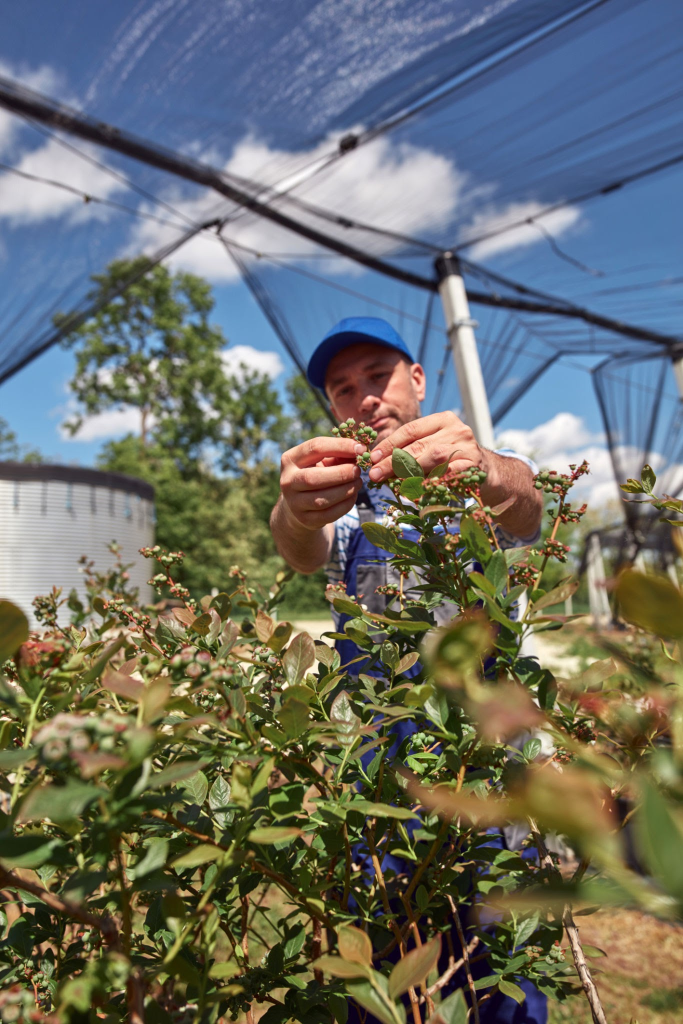
Fine observation and nutritional conditioning during the spring budding period. Source: m-gucci / Getty Images
2. Mulch Renovation and Micro-Ecological Stabilization
The shallow, fibrous architecture of blueberry roots—with the vast majority of the biomass residing in the top 0–30 cm of the soil profile—renders them exceptionally vulnerable to rapid fluctuations in surface temperature and moisture. Once winter debris and degraded materials are cleared in early spring, a fresh organic mulch layer of 5–10 cm must be established.
The premier choices for mulching include aged pine needles, weathered pine bark nuggets, or acidic sphagnum peat moss. These materials do more than suppress competitive weed germination and stabilize soil moisture; as they slowly decompose, they continuously release organic acids that reinforce the low pH of the rhizosphere. Crucially, the highly porous nature of pine bark and peat creates an ideal structural matrix for mycorrhizal fungi to proliferate, maximizing the plant’s nutrient uptake efficiency during its primary vegetative push.
3. Nutrient Activation: Ammonium Dynamics and Nitrogen Delivery
The convergence of leaf bud break and rapid inflorescence development in early spring creates an exponential spike in the plant’s demand for nitrogen. However, blueberries possess a distinctive evolutionary preference for their nitrogen source: they are highly inefficient at processing nitrate ($NO_3^-$) and instead rely almost exclusively on ammonium ($NH_4^+$).
Accordingly, the first fertilizer application of the season—timed precisely at the “green tip” stage when buds begin to swell and flash color—must utilize ammonium sulfate or urea. Ammonium sulfate serves a dual purpose: it supplies immediately accessible nitrogen while delivering sulfur ions that help stabilize soil acidity. Application rates must be tailored strictly to plant age and historical crop loads. Excessive early nitrogen application triggers unchecked vegetative flushing, producing elongated, succulent shoots with poor lignification. This leaves the plant highly susceptible to late frost damage and sets up an internal nutrient competition where leaves outcompete developing blossoms, leading to premature flower drop.
4. Mitigation Strategies for Late Spring Frosts
As blueberry tissues transition out of winter dormancy and progress through reproductive stages, their tolerance to sub-zero temperatures plummets dramatically. While a fully dormant winter cane can withstand temperatures well below -20°C, open flowers and tender green tissue can suffer severe damage at temperatures between -2.2°C and -0.5°C.
Modern spring management demands real-time monitoring of radiative frost events. The primary defense in commercial operations is the deployment of overhead impact sprinklers before ambient temperatures hit the freezing point. As water transitions from liquid to ice on the surface of the plant, it releases a small but critical amount of latent heat (latent heat of fusion), maintaining the coated plant tissues at a stable 0°C. Additional defensive measures include the use of large-scale wind machines to pull warm air down from atmospheric inversion layers, or heater systems designed to break up cold air pockets in low-lying areas of the orchard.
II. Summer Flourishing: Cellular Expansion, Hydrological Equilibrium, and Fruit Optimization
Summer marks the transition from structural development to intense reproductive execution. As ambient temperatures rise, the carbohydrate resources of the plant shift entirely toward fruit swelling, ripening, and harvest. During this peak period, blueberry seasonal care centers on meticulous water management, precision foliar nutrition, and integrated pest and disease suppression.
1. Transpiration Control and High-Frequency Irrigation
The high solar radiation and elevated temperatures of summer generate immense evapotranspiration (ET) demands. Because blueberries lack a deep taproot and root hairs, their natural drought tolerance is exceptionally low. Even brief periods of water deficit during the fruit enlargement phase will instantly stall cell division, leading to shriveled, sun-scalded, or unmarketable fruit.
During the fruit-set and sizing windows, the orchard’s irrigation strategy must shift to a high-frequency, low-volume drip protocol. Based on real-time soil moisture sensors, the water content within the primary root zone should be maintained continuously at 60% to 70% of field capacity. Irrigation cycles are best executed during the cooler windows of early morning or late evening to suppress evaporative losses. In regions prone to intense summer heatwaves, subterranean drip irrigation can be supplemented with brief, intermittent overhead micro-misting. This practice lowers the canopy microclimate temperature, preventing the plant from entering a defensive photosynthetic shutdown (midday depression).
2. Targeted Foliar Interventions: Potassium, Calcium, and Boron
During the rapid transition from fruit color-turn to final ripening, traditional soil-applied fertilizers often lack the rapid translocation speeds necessary to match the fruit’s instantaneous nutritional demands. Strategic foliar spraying during these developmental windows directly enhances fruit quality.
- Boron (B): Applied during late bloom and early fruit-set, boron criticalizes pollen tube elongation, maximizing seed count per berry, which correlates directly with uniform fruit sizing.
- Potassium (K): Potassium acts as the primary osmotic regulator and carbohydrate shuttle within the plant. Spraying high-grade potassium solutions just before the fruit shifts from green to pink forces the rapid translocation of sugars into the berries, maximizing soluble solids (°Brix) and berry weight.
- Calcium (Ca): Calcium is essential for building structural integrity within the cell walls and middle lamella of the fruit skin. Multiple low-dose applications of chelated calcium during the summer significantly increase skin elasticity and flesh firmness. This intervention drastically lowers the incidence of fruit splitting during sudden summer rainstorms and extends post-harvest shelf life.
3. Integrated Pest and Disease Management (IPM)
The warm, humid canopies of summer create an ideal incubator for a variety of pathogens and pests. Growers must employ a proactive Integrated Pest Management framework to protect the crop safely.
Anthracnose Fruit Rot (Colletotrichum spp.) and Botrytis Blight (Botrytis cinerea)
These fungal pathogens represent severe threats to fruit quality. While infections often occur early during spring bloom, the pathogens remain latent until the fruit accumulates sugars and ripens in the summer. Prevention relies on summer pruning to open the canopy, optimizing air circulation and sunlight penetration to lower relative humidity within the foliage. Protective and systemic fungicides must be rotated strategically ahead of predicted summer rains, always adhering strictly to Pre-Harvest Intervals (PHI).
Spotted Wing Drosophila (Drosophila suzukii / SWD)
As a premier pest of the global blueberry industry, the female SWD uses a specialized, serrated ovipositor to pierce the skin of healthy, ripening fruit to deposit eggs. The developing larvae quickly liquefy the internal fruit pulp, causing rapid fruit collapse. Throughout the summer, growers must deploy apple cider vinegar or yeast-baited traps to monitor pest pressure. Upon confirmation of SWD presence, targeted applications of organic or chemical controls (such as spinosad) must be coordinated with frequent, clean harvesting. Leaving overripe or damaged fruit on the bush provides an active breeding ground that amplifies the pest population.
| Key Summer Threat | Primary Target | Environmental Catalyst | Core Management Strategy |
| Anthracnose | Fruit, tender shoots | High heat, high humidity | Open-canopy pruning, pre-rain fungicide rotation |
| Botrytis Blight | Blossoms, mature fruit | Cool, prolonged summer rains | Strict moisture control, structural canopy airflow |
| Spotted Wing Drosophila | Ripening/Vibrant fruit | Elevating sugar levels, fruit aromas | Precision trapping, biological controls, short harvest intervals |
4. Physical Avian Exclusion Systems
The visual transition of blueberries from green to deep blue serves as a powerful attractant for local bird populations. In commercial operations, acoustic deterrents or reflective tapes yield diminishing returns as birds quickly adapt to the stimuli. The most dependable method for protecting high-value crops is the installation of structural exclusion bird netting before fruit color transition begins. A net mesh size of approximately 2 cm provides an absolute physical barrier against birds without compromising solar radiation reception or air movement.
III. Autumn Consolidation: Photosynthetic Accumulation, Flower Initiation, and Nutrient Acclimatization
A common misconception among novice growers is that management pauses once the final berries are harvested. In reality, autumn is the critical window that dictates the yield potential of the following year. During this phase, blueberry plants undergo complex physiological shifts, transitioning from active vegetative growth into structural hardening and flower bud differentiation.
1. Flower Bud Initiation and Hormonal Shifts
As daylengths drop below 12 hours and diurnal temperature fluctuations widen in early autumn, the plant’s internal hormone profile shifts. The concentration of gibberellins (which promote active vegetative growth) declines, while abscisic acid (ABA) and cytokinins rise. This biochemical shift signals the apical and sub-apical meristems on the current season’s wood to transition from vegetative leaf buds into reproductive flower buds.
To ensure robust, fully formed flower primordia, the plant requires targeted nutritional support, but it must be entirely free from aggressive nitrogen stimulation. Autumn applications should focus exclusively on low-nitrogen, high-phosphorus, and high-potassium formulations. Phosphorus fuels the intense cellular energy expenditures (ATP synthesis) required for flower morphogenesis, while potassium facilitates the translocation of leaf-synthesized carbohydrates (starches and soluble sugars) down into the canes and root systems for winter storage.
2. Growth Cessation and the Lignification Process
The primary pitfall in autumn management is encouraging late-season vegetative flushes. Over-fertilizing with nitrogen or over-watering in early to mid-autumn coaxes the plant into throwing out tender, succulent green shoots. These late flushes fail to undergo proper lignification before the arrival of the first autumn frosts, resulting in severe tip dieback and entering winter as open vectors for bacterial infections like bacterial canker (Pseudomonas syringae).
To prevent this, growers must completely halt nitrogen inputs by late summer and gradually extend the intervals between irrigation cycles. Introducing a controlled, mild moisture stress in mid-autumn signals the plant to cease structural elongation. This triggers the accumulation of solutes—such as sugars and proline—within the plant cells, lowering the freezing point of the intracellular fluid and preparing the canes to withstand freezing winter temperatures.
3. Phytosanitary Sanitation and Pathogen Interception
The period of natural leaf drop in late autumn represents a vital sanitary window. Many devastating fungal pathogens, including leaf spot diseases and mummy berry (Monilinia vaccinii-corymbosi), overwinter as sclerotia or mycelia within fallen leaves, mummified fruits, and dead twigs on the orchard floor.
Once leaf drop is complete, a thorough orchard cleanup is mandatory. All fallen foliage and mummified fruit should be mechanically flail-mowed, buried, or physically removed from the growing site. Following sanitation, a comprehensive application of a heavy copper fungicide or lime sulfur should be sprayed across the entire canopy. This late-autumn wash blankets the bark fissures and bud scales, neutralizing overwintering fungal spores and insect eggs, thereby lowering the baseline disease pressure for the upcoming spring.
IV. Winter Rest: Structural Pruning, Chilling Accumulation, and Dormant Protection
During the depth of winter, the blueberry plant enters endodormancy. While outwardly quiescent, the plant is executing two critical biological processes: tracking chilling accumulation to break dormancy, and adjusting its cellular osmolytes to endure sub-zero temperatures. For the grower, this quiet season is the window for high-skill structural pruning.
1. Tracking the Chilling Requirement
To resume normal vegetative growth and uniform flowering in the spring, blueberries must experience a specific duration of cold temperatures during their winter rest. This biological metric is known as the “chilling requirement,” typically calculated as the cumulative hours spent between 0°C and 7.2°C.
Chilling requirements vary profoundly across genetic classifications. Northern Highbush varieties generally demand 800 to over 1,000 chilling hours to break dormancy, whereas Southern Highbush and Rabbiteye cultivars are adapted to warmer climates, requiring only 150 to 600 hours. Commercial growers track these hours using automated weather stations. If a low-chill variety is grown in a high-chill zone, it may bloom prematurely and face frost destruction; conversely, if a high-chill variety experiences an atypically warm winter, spring bud break will be erratic, flower buds will abort, and leaf canopy development will be severely delayed.
2. Dormant Pruning: The Architecture of Sustained Productivity
Dormant pruning is the most technically demanding aspect of blueberry seasonal care. Blueberries produce their finest fruit on vigorous canes that are between 2 and 6 years old. Canes that exceed 7 to 8 years of age suffer from degraded vascular efficiency, yielding progressively smaller, lower-quality berries.
Pruning is best executed in late winter or very early spring, just before sap flow resumes. At this stage, stored carbohydrates have completely retreated into the crown and root structures, minimizing nutrient loss from the cuts. The pruning process follows a systematic structural logic:
1. Sanitize the Canopy Base (Apply the 3D Rule: Remove Dead, Damaged, and Diseased wood)
   ↓
2. Execute Cane Renewal Cuts (Remove 1-2 of the oldest, low-productivity canes at the base)
   ↓
3. Clear the Canopy Interior (Remove weak, crossing, or inward-growing brush to maximize airflow)
   ↓
4. Calibrate Crop Load (Head back overly long fruit canes to balance the ratio of flower buds to leaf buds)
The Physiological Balance of Pruning: Each individual flower bud contains a compressed cyme that will expand into 5 to 12 individual flowers. Failure to prune away excess flower buds in the winter results in an over-managed fruit set that exhausts the plant’s carbohydrate reserves. This leads to undersized fruit and induces a cycle of alternate bearing, where the plant produces a massive crop one year followed by little to no crop the next. As a general rule, healthy lateral canes are headed back to leave only the top 3 to 5 plump flower buds, ensuring a balanced leaf-to-fruit ratio.
3. Crown Stabilization and Deep-Winter Mitigation
In regions subjected to severe continental winter conditions, cold desicating winds pose a major threat to plant survival. The crown of the plant—the transition zone between the root architecture and the aerial canes—is highly sensitive; if the crown freezes through, the primary vascular connection of the plant is destroyed.
Before deep-winter freezes arrive, growers should bank additional organic mulch or soil around the base of the crowns. In small-scale or ultra-premium setups, vulnerable cultivars can be wrapped with breathable frost blankets. Ensuring the soil is adequately hydrated before the ground freezes (late-autumn winterization irrigation) is another valuable defense. Wet soil possesses a significantly higher specific heat capacity than dry soil, allowing it to retain latent ambient warmth longer and buffering the shallow root zone against rapid, catastrophic temperature drops.
V. Adapting Seasonal Care to Global Climate Shifts
Modern blueberry cultivation is facing a shifting baseline due to global climate volatility. Traditional calendar-driven management schedules are increasingly falling out of alignment with real-world weather patterns. Unexpected late-spring frosts, prolonged summer heatwaves that break historical records, extended autumn droughts, and unseasonably warm winters mean that growers must shift from a rigid, calendar-based approach to a highly responsive, growth-stage-driven model.
To navigate these shifts, advanced operations are integrating Internet of Things (IoT) sensors and precision agriculture tools. Telemetric soil probes track changes in moisture, temperature, and electrical conductivity (EC) across the root zone, while infrared sensors continuously evaluate canopy temperature stress.
For instance, if summer sensor arrays report canopy temperatures exceeding the critical photosynthetic threshold of 32°C, automated micro-misting systems can instantly engage to cool the plants. In autumn, real-time leaf tissue analysis allows growers to adjust nutrient inputs to ensure optimal winter hardiness, rather than relying on historical timelines. Integrating digital monitoring with an understanding of blueberry physiology allows modern growers to protect their crops from environmental extremes and maintain consistent, high-quality production year after year.