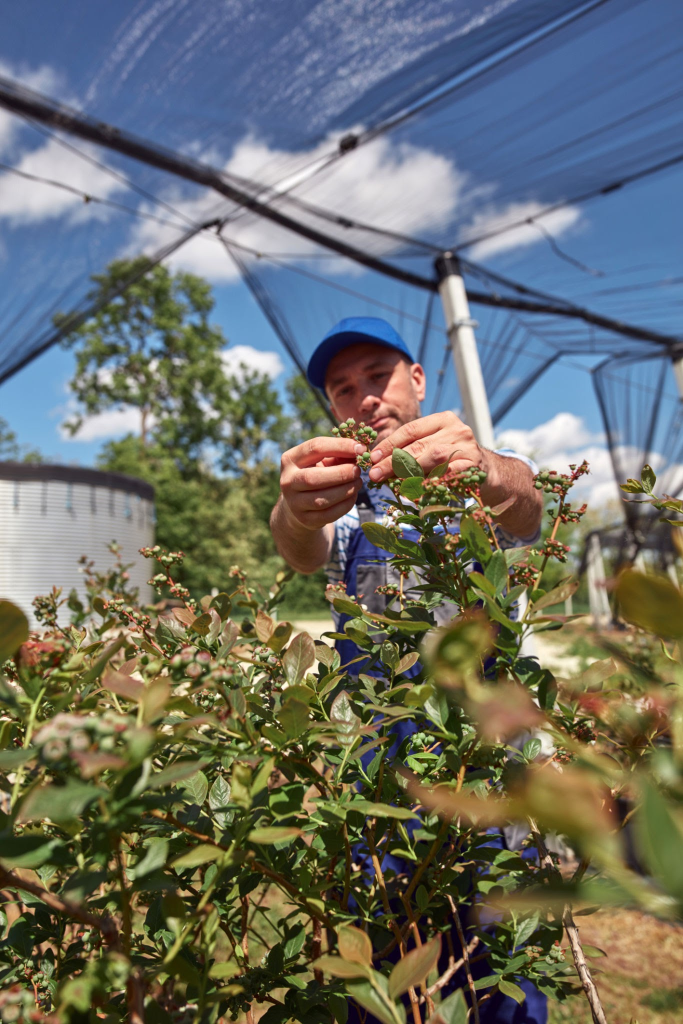
Blueberry production has shifted from a niche horticultural activity into a highly structured global industry driven by export demand, supermarket standards, and year-round supply chains. As commercial farms expand across diverse climates and soil conditions, container-based cultivation has become one of the most reliable systems for achieving consistent yields and premium fruit quality. Within this transformation, the choice of blueberry pots is no longer a secondary technical detail—it is a core production decision that directly shapes plant health, operational efficiency, and long-term profitability.
For growers entering or scaling up blueberry container farming, the selection of a suitable container system often determines whether a project becomes a stable commercial success or a constant struggle with inconsistent growth and hidden root-zone problems. Unlike traditional field planting, container systems fully define the root environment. Every aspect of water movement, oxygen availability, nutrient retention, and thermal balance depends on the structure of the pot itself.
This is why experienced growers increasingly evaluate not just the plant variety or fertilizer program, but the entire blueberry pot system as a unified production framework. In modern commercial agriculture, pots are no longer passive vessels. They are engineered growing environments that actively influence plant physiology.
Choosing the right system requires understanding how blueberries behave in controlled environments, how containers interact with irrigation and climate conditions, and how long-term production goals influence design requirements.
The Shift Toward Container-Based Blueberry Production
The global expansion of blueberry consumption has created a production model that relies heavily on flexibility and geographic diversification. Countries that previously lacked suitable acidic soils are now major exporters thanks to container cultivation systems.
This shift is not only economic but also agronomic. Blueberries are highly sensitive to soil pH, drainage capacity, and root oxygen levels. In open-field systems, these variables are difficult to control consistently across large areas. Container cultivation solves this by allowing growers to build an artificial root environment that can be replicated at scale.
Within this system, the container becomes the foundation of production. Whether used in open-field orchards, greenhouse tunnels, or high-density commercial farms, the pot defines how roots develop and how efficiently the plant can absorb water and nutrients.
As a result, modern growers increasingly evaluate container performance with the same seriousness traditionally reserved for irrigation systems or fertilizer programs.
Why Container Design Determines Root Health
Blueberry plants have a naturally shallow and fibrous root structure. They depend on a delicate balance between moisture and oxygen in the root zone. When conditions become too wet, oxygen availability decreases rapidly, and root metabolism slows down. When conditions are too dry, nutrient uptake becomes limited and plant stress increases.
This balance is extremely sensitive, especially in commercial systems where irrigation cycles are frequent and environmental conditions vary throughout the season.
In container systems, drainage performance becomes the primary regulator of this balance. A well-designed pot ensures that excess water is removed efficiently while maintaining enough moisture within the substrate to support continuous root activity.
Poorly designed containers, on the other hand, can create hidden water accumulation zones that remain saturated long after irrigation events. These zones often lead to oxygen starvation, root rot development, and uneven plant growth across a field.
This is why professional growers increasingly prioritize large blueberry containers designed with engineered drainage pathways and structural elevation features.
The Relationship Between Container Volume and Plant Performance
One of the most important but often misunderstood aspects of blueberry cultivation is the relationship between container size and root development.
Larger containers provide more stable moisture conditions, reducing the frequency of extreme fluctuations between dry and wet states. This stability is particularly important in commercial farming environments where irrigation cycles may be automated and applied uniformly across large areas.
However, container size alone does not guarantee better performance. Without proper drainage design, large containers can actually worsen water retention issues. The deeper substrate profile may trap moisture in lower zones, creating anaerobic conditions that are difficult to detect visually.
This is why modern systems focus not just on volume, but on integrated design. A well-engineered container balances size, drainage efficiency, airflow, and structural strength.
When these factors are properly aligned, the result is a more stable root environment that supports consistent growth throughout the production cycle.
Water Management as the Core of Commercial Success
In commercial blueberry farming, water management is one of the most critical operational challenges. Both over-irrigation and under-irrigation can lead to significant yield losses, but over-irrigation is often more damaging because it affects root function directly.
Container systems intensify this challenge because they limit natural drainage pathways. Unlike soil-based systems where water can disperse laterally or vertically into deeper layers, containers rely entirely on engineered drainage structures.
This makes irrigation strategy and container design inseparable.
A well-designed blueberry pot system ensures that water moves efficiently through the substrate while maintaining sufficient retention for plant uptake. It also prevents the formation of stagnant zones that can disrupt oxygen flow.
Commercial growers often discover that improving container drainage performance can have a greater impact on yield consistency than adjusting fertilizer programs or irrigation schedules.
This is because root health is the foundation upon which all other inputs depend.
Oxygen Availability and Root Efficiency
While water management is often the most visible concern, oxygen availability is equally important in container systems.
Blueberry roots require continuous oxygen supply for respiration. When oxygen levels drop, root efficiency declines rapidly. This affects not only water uptake but also nutrient absorption and overall plant vigor.
In poorly drained containers, oxygen diffusion becomes restricted as water fills the pore spaces within the substrate. Even short periods of saturation can significantly reduce root activity.
Modern container systems address this challenge through structural elevation, side ventilation, and bottom drainage optimization. These design features help maintain air exchange within the root zone, ensuring that oxygen remains available even during periods of frequent irrigation.
The most effective systems treat oxygen management and water management as interconnected processes rather than separate variables.
Temperature Stability in Container Systems
Another important factor in choosing blueberry containers for commercial farms is temperature regulation.
Containers are more exposed to environmental temperature fluctuations than in-ground systems. During hot weather, substrate temperatures can rise quickly, affecting root metabolism and water demand. During cold periods, root activity slows and nutrient uptake becomes less efficient.
Large-scale commercial farms often operate in regions with significant temperature variation, making thermal stability a key design consideration.
High-quality container systems are designed to moderate temperature changes by improving airflow, reducing heat accumulation, and maintaining consistent moisture distribution.
When temperature stability is improved, plants experience less stress and maintain more predictable growth patterns throughout the season.
Structural Durability in Commercial Operations
Commercial blueberry farms operate at scale, which means containers must withstand repeated handling, seasonal reconfiguration, and long-term exposure to UV radiation and environmental stress.
Structural failure in a container system can lead to significant operational disruption. Cracked pots, deformed bases, or blocked drainage pathways can compromise entire sections of a production field.
For this reason, professional growers prioritize materials and designs that maintain structural integrity over multiple seasons.
Durability is not just a cost consideration. It directly affects production reliability and labor efficiency.
A stable container system reduces maintenance requirements and ensures that drainage performance remains consistent over time.
The Role of Root Architecture in Yield Formation
Blueberry yield is closely linked to root structure. Healthy root systems support more efficient nutrient transport, stronger vegetative growth, and more uniform fruit development.
Container design influences root architecture significantly.
In poorly designed systems, roots may circle around container walls or concentrate in limited zones with better oxygen availability. This uneven distribution reduces overall absorption efficiency and can create variability in plant performance.
In contrast, well-designed containers promote more uniform root expansion. Some advanced systems even encourage air-pruning effects that stimulate branching and improve root density.
The result is a more efficient root system capable of supporting higher and more consistent yields.
Integration With Irrigation and Fertigation Systems
Modern commercial blueberry farms rarely operate containers in isolation. Instead, they are integrated with drip irrigation and fertigation systems that deliver water and nutrients directly to the root zone.
Container design must therefore be compatible with these systems.
Uniform drainage ensures that nutrients are distributed evenly throughout the substrate. If drainage is uneven, fertilizer concentrations can vary significantly between different parts of the container, leading to inconsistent plant performance.
Efficient container systems help stabilize nutrient movement and improve uptake efficiency, reducing waste and improving cost-effectiveness.
Scaling Production With Consistent Container Systems
One of the main advantages of container-based blueberry farming is scalability.
Once a successful system is established, it can be expanded across large areas with relatively consistent results. However, this scalability depends heavily on container uniformity.
If containers vary in drainage performance, size, or material quality, plant development becomes inconsistent across the farm. This inconsistency can complicate harvest timing and reduce operational efficiency.
For this reason, commercial farms often standardize container systems across entire production sites.
Consistency becomes a key driver of profitability.
Long-Term Productivity and Economic Efficiency
Blueberry plants are long-term crops. In many commercial systems, plants remain productive for many years.
Container systems must therefore support long-term root health and structural stability.
A high-quality system reduces plant replacement rates, minimizes disease risk, and improves yield consistency over time.
While initial investment in premium containers may be higher, the long-term economic benefits often outweigh the cost difference.
Reduced crop losses, improved fruit quality, and more stable production cycles all contribute to higher overall returns.
The Importance of System-Level Thinking
Choosing blueberry pots for commercial farms is not simply a matter of selecting individual containers. It requires system-level thinking.
The container interacts with irrigation, climate, substrate composition, plant genetics, and farm management practices. Each of these elements influences the others.
A successful blueberry pot system is one where all components work together to create a stable and predictable root environment.
This is why experienced growers evaluate containers not in isolation but as part of a broader production ecosystem.
Transition to Advanced Commercial Solutions
As commercial blueberry production becomes more competitive, growers are increasingly turning to specialized engineered systems designed specifically for high-density production environments. These systems integrate drainage optimization, structural reinforcement, airflow management, and scalability considerations into a unified design.
In modern operations, choosing the right container is no longer just a procurement decision—it is a strategic investment in farm performance, consistency, and long-term profitability.
For growers seeking optimized solutions tailored for commercial-scale production, modern systems of professional blueberry grow pots offer engineered drainage structures, improved root-zone aeration, and durable designs built specifically for intensive agricultural use. These systems support stable root development, reduce waterlogging risks, and enhance overall production efficiency across large-scale blueberry container farming operations.
In today’s global blueberry industry, success increasingly depends on precision, consistency, and system integration. And at the center of that system lies the container itself—quietly shaping every aspect of plant growth, yield potential, and commercial performance.