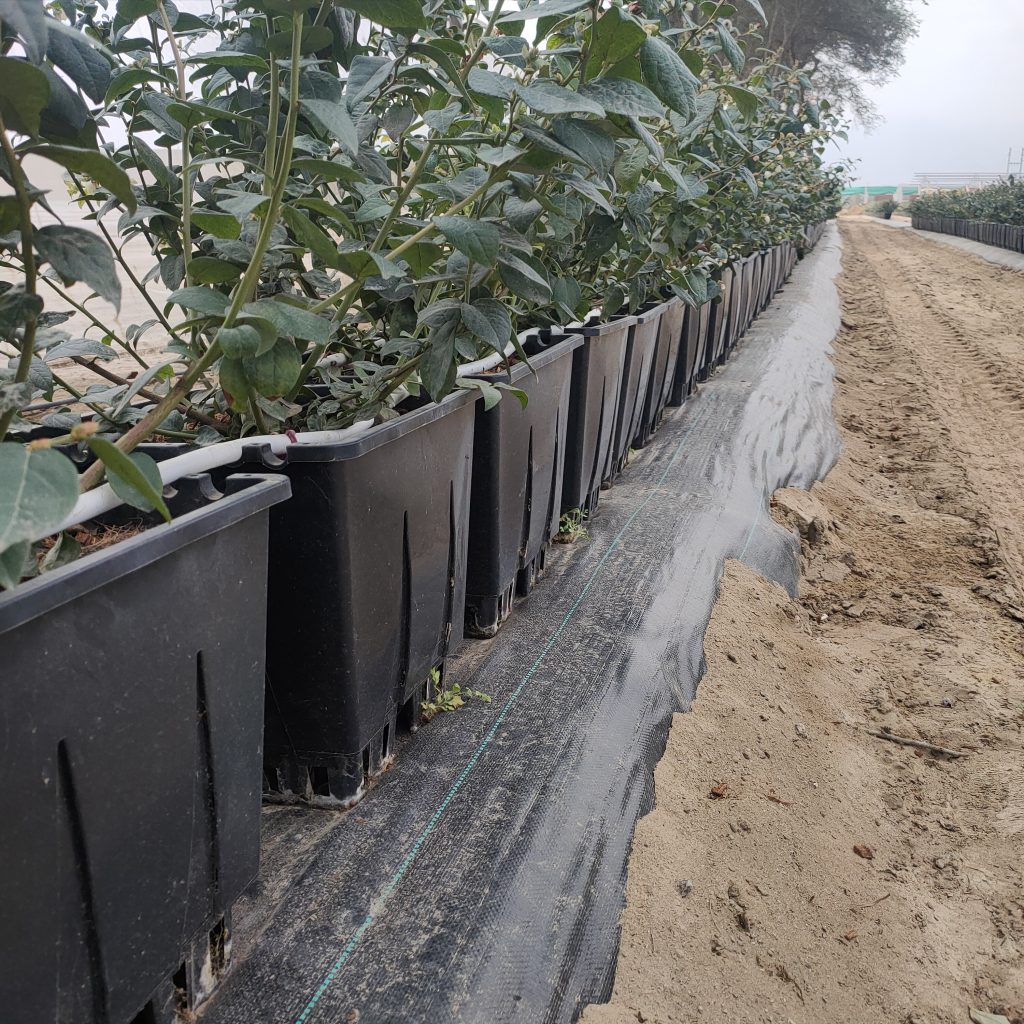
For commercial blueberry growers, the question of “what is the best growing system?” is not simply a matter of choosing equipment. Once blueberry production moves to a commercial scale, the growing system must do far more than support plant growth. It needs to maintain a stable root-zone environment over multiple production cycles, enable precise water and nutrient management, accommodate appropriate planting density, and deliver predictable production performance over the long term.
Unlike many conventional fruit trees, blueberries have relatively fine and delicate root systems with limited root hairs, making them highly sensitive to changes in root-zone moisture, oxygen availability, pH, and salinity. If the root zone remains excessively wet for an extended period, the plants may continue to appear healthy above ground, while the roots gradually lose their ability to absorb water and nutrients effectively. At the same time, commercial production requires a growing system that can support large-scale irrigation, fertigation, pruning, harvesting, and future expansion.
For this reason, the more relevant question is not simply “which is better, growing in soil or growing in containers?” Instead, it is: what type of system can maintain a stable root-zone environment while making the overall commercial production process easier to manage and control?
This is also why growing system design has become increasingly important in modern commercial blueberry growing.
The Evolution and Technical Development of Commercial Blueberry Growing Systems
Before discussing which growing system is the most suitable, it is essential to understand the fundamental differences between conventional soil-based cultivation and modern soilless growing systems. Traditional field cultivation is constrained by inherent soil-related factors such as pH, drainage, and soil-borne diseases. In contrast, a modern commercial blueberry growing system uses controlled growing media, engineered growing environments, and precision management technologies to provide much greater control over root-zone conditions.
Today, the main commercial growing approaches can generally be divided into three categories.
Traditional soil-based cultivation relies on soil amendments and raised-bed production. Although the initial cost of establishing an orchard can be relatively low, this approach remains highly dependent on local soil pH and drainage conditions, which can increase management complexity and may result in a longer path to consistent commercial production.
Raised-bed systems with mulch and partial soilless cultivation involve forming raised beds above the existing soil and installing weed-control fabric and drip irrigation. Coconut coir or pine bark may be incorporated into the growing area to improve localized root-zone conditions. This approach can be viewed as an intermediate solution between conventional field cultivation and fully containerized production.
Soilless container growing systems, also referred to as substrate-based container systems, use dedicated above-ground growing containers combined with specially selected substrates such as coconut coir and precision fertigation systems. This approach is increasingly used for high-density commercial blueberry production because it provides greater control over the root-zone environment and allows irrigation and nutrient delivery to be managed more precisely.
When factors such as yield potential, fruit quality, water and nutrient use efficiency, and the potential for earlier commercial returns are considered together, soilless container production offers a highly controllable approach for modern high-density blueberry operations. For growers focused on intensive commercial production, it has therefore become an increasingly important direction in the development of commercial blueberry growing systems.
What Makes a Commercial Blueberry Growing System Suitable for Commercial Production?
A growing system that is genuinely suitable for commercial blueberry production should address the root-zone environment first, before considering factors such as cost, planting density, and operational efficiency.
If a growing system only reduces the initial establishment cost but makes irrigation management more difficult, or creates significant root-zone limitations as the plants mature, a lower upfront cost does not necessarily translate into lower operating costs over the long term.
Conversely, when a system can provide relatively consistent root-zone conditions for each blueberry plant, irrigation, fertigation, and crop management become much easier to standardize across the production operation.
Designing a Blueberry Growing System from the Root Zone Up
Blueberry roots are highly sensitive to oxygen deficiency. Therefore, the primary concern for a commercial growing system is not simply avoiding “insufficient water,” but maintaining the right balance between moisture and air within the root zone.
The growing medium needs to retain sufficient moisture to support plant transpiration and nutrient uptake. However, if excess water cannot drain away efficiently after irrigation, the root zone may remain saturated for extended periods. According to UF/IFAS resources, commercial container-grown blueberries are typically managed with short-duration, high-frequency irrigation and fertigation, while drip irrigation is used to improve water control and distribution uniformity. Drainage and salinity management also need to be coordinated with the overall irrigation strategy.
Therefore, a mature blueberry growing system should not evaluate the container, growing medium, or drip irrigation lines in isolation. Instead, these three components should be designed and managed as an integrated system.
The container defines the available root-zone volume and drainage boundaries, the growing medium determines how water and air are distributed within the root zone, and the irrigation system controls the timing and delivery rate of water and nutrients. If any one of these components is poorly matched with the others, the performance of the entire system can be affected.
Yield Optimization and Management Strategies for Commercial Blueberry Production
In commercial blueberry production, return on investment (ROI) is an important factor when evaluating the overall performance of a growing system. Compared with conventional field cultivation, substrate-based container systems can offer significant commercial advantages in production management.
Higher planting density: Conventional field cultivation is often constrained by plant and row spacing, whereas container-based systems can allow growers to substantially increase the number of plants per unit area. In some production models, planting density can be increased by more than 50%, making more efficient use of available land.
Shorter time to production: Under well-managed soilless growing conditions, blueberry plants can establish and develop rapidly during the first year and may begin producing commercially significant yields in the second year. Depending on the cultivar, climate, plant material, and management practices, this can potentially shorten the time required to begin generating returns compared with conventional field production.
More efficient water and nutrient management: An integrated irrigation and fertigation system can improve water and fertilizer-use efficiency while allowing nutrient programs to be adjusted according to different stages of blueberry development, including flower-bud development, fruit enlargement, and ripening. This level of control can help growers respond more precisely to changing crop requirements.
Greater consistency in fruit quality: More controlled root-zone conditions can contribute to greater uniformity in fruit characteristics such as berry size, firmness, soluble solids, and bloom retention. Greater consistency can be particularly valuable for commercial growers supplying demanding fresh-market and export channels.
The success of commercial blueberry production depends not only on the hardware configuration of the growing system, but also on how effectively the hardware is integrated with day-to-day crop management. Regular monitoring of the EC and pH of both the irrigation solution and the drainage or runoff is an important part of maintaining stable root-zone conditions and identifying potential irrigation, nutrient, or salinity issues before they become more serious.
Irrigation Management as the Control Center of a Commercial Growing System
If the container defines the spatial boundaries of the root zone, the irrigation system determines how water and nutrients enter that space.
Commercial blueberries generally require more precise irrigation management than conventional horticultural crops. Plant transpiration varies with temperature, light intensity, wind speed, and growth stage, while the volume of growing medium in a container is relatively limited. As a result, moisture levels within the root zone can change much more rapidly than in open-field conditions.
This is where drip irrigation becomes particularly valuable, as it allows water and nutrients to be delivered to the root zone with greater precision.
However, precision irrigation does not simply mean setting a fixed watering schedule each day. The same irrigation program can produce very different results under cool weather conditions compared with periods of high temperature and strong evaporative demand.
A well-designed blueberry growing system should therefore allow growers to continuously adjust irrigation strategies according to actual environmental conditions and crop requirements.
As commercial agriculture becomes increasingly data-driven, more growers are using weather data, growing-medium moisture conditions, drainage or runoff measurements, and plant performance to determine when irrigation strategies need to be adjusted. The goal is not simply to add more technology, but to make water and nutrient delivery more closely aligned with the plant’s actual requirements.
Why Maximum Yield Should Not Be the Only Standard
When growers compare different commercial blueberry growing systems, it is easy to treat yield as the primary, or even the only, measure of performance.
However, for commercial fresh-market blueberries, yield represents only one part of the overall economic outcome.
Blueberries ultimately move through harvesting, sorting, packaging, cold-chain logistics, and sales. As a result, factors such as fruit size, firmness, maturity uniformity, shelf life, and harvesting efficiency can all have a significant impact on the final return from production.
For example, a system may achieve a high yield per unit area, but if plant growth is inconsistent and fruit maturity is highly uneven, harvesting may require more labor and multiple picking rounds. In contrast, when a growing system provides more uniform root-zone conditions across the production area, plant growth and crop management may become easier to standardize.
This is why modern commercial blueberry production is increasingly focused on the entire production chain rather than field yield alone.
From a long-term business perspective, an effective growing system should help growers reduce production uncertainty and maintain more predictable overall performance, rather than simply maximizing a single production metric.
Which Growing System Is Better Suited for Long-Term Commercial Blueberry Farming?
Once land, containers, growing media, irrigation, and production management are considered as an integrated system, it becomes clear that the “best” growing system ultimately depends on the specific project.
If the local soil is naturally well suited to blueberries, with favorable drainage, acidity, and water quality, a field-based system may offer cost advantages.
When site conditions present significant limitations, or when growers want greater control over the root-zone environment, container and substrate-based systems may be more attractive.
For large-scale commercial projects, the primary value of a container system is not that it is “more advanced” than soil-based cultivation, but that it gives growers more direct control over the root-zone environment.
Once the root zone is moved from natural soil into purpose-designed containers and growing media, growers can manage factors such as root-zone volume, drainage, irrigation, and substrate composition with greater precision. At the same time, the production system becomes easier to standardize and replicate.
This is particularly important for commercial blueberry farming operations that plan to expand their growing area over time.
What Makes a Commercial Blueberry Growing System a Long-Term Investment?
A system that is truly worth investing in for the long term should, first and foremost, provide stability.
Commercial blueberries are not an annual crop, so growers cannot evaluate a growing system based solely on its performance during the first year. Containers, growing media, and irrigation systems should all be planned and selected with multi-year use in mind.
Second, the system should be scalable.
If a system is suitable for only a few dozen plants but requires a complete redesign once the growing area expands, it is difficult to serve as the foundation for a large commercial farm. By contrast, if the container specifications, irrigation layout, and substrate management practices can be replicated as the production area expands, the system offers greater long-term value.
Finally, supply stability is another important consideration.
Commercial growers often need to purchase the same or similar product specifications consistently over time. If a supplier can only support an initial project but cannot maintain consistent specifications during future expansion, some of the advantages of the original system design may be compromised.
Therefore, when evaluating a commercial blueberry growing system, growers should also consider the supplier’s production capacity, customization capabilities, product consistency, and ability to provide long-term support.
How Does Naturehydro Fit into a Commercial Blueberry Growing System?
For commercial blueberry farms using container-based production, growing containers should not be viewed simply as plastic products separate from the production system. They are an integral part of root-zone management. Container capacity, bottom drainage, support height, and material durability can all influence subsequent irrigation, substrate management, and daily farm operations. Therefore, when selecting a supplier, commercial growers should pay greater attention to whether the products can perform reliably under real farm conditions over the long term, and whether the supplier can provide specifications suited to the requirements of different projects.
For example, Naturehydro offers commercial blueberry growing containers in a range of capacities and structural designs, allowing growers to select round or square containers as well as different drainage and support configurations according to project requirements. For buyers planning large-scale production projects, looking at containers from the perspective of overall root-zone requirements rather than simply comparing the unit price of individual pots can often provide a more practical basis for system planning.
From this perspective, evaluating a commercial blueberry growing system should not stop at asking “which growing method produces the highest yield?” What matters more is whether the system can maintain stable root-zone conditions over the long term, make water and nutrient management repeatable, adapt to seasonal environmental changes, and remain scalable as the farm expands. For projects that rely on containers to control the root-zone environment, factors such as container specifications, drainage design, and commercial growing applications can all serve as useful references when planning the production system. Ultimately, the appropriate solution should be determined by considering the local climate, cultivar characteristics, growing-medium conditions, irrigation capacity, planting density, and expected production cycle as a whole.
Therefore, a “best growing system” does not mean that every commercial blueberry farm should adopt exactly the same system. Rather, it means finding a solution that fits the specific conditions and production objectives of the farm. If container-based production is selected, container size, substrate volume, drainage design, and irrigation layout should be considered together at the early planning stage, rather than adjusted individually after planting is already underway. This is particularly important for growers planning their first commercial blueberry farming project, because container selection and root-zone design can influence operations for many years. Before finalizing specifications, it is therefore useful to understand how different container designs affect root-zone space, moisture management, and overall production efficiency. For a closer look at these considerations, How to Choose Containers for Blueberry Farming provides additional guidance on evaluating container capacity, structure, and commercial applications.
Ultimately, the value of a commercial blueberry growing system is not determined by how much equipment it adds, but by how effectively it transforms a complex and constantly changing root-zone environment into production conditions that are easier to monitor, adjust, and manage. When containers, growing media, irrigation, and crop management work together as a stable system, a blueberry growing system is better positioned to support long-term commercial blueberry production. For commercial growers, rather than searching for a “one-size-fits-all” system detached from actual farm conditions, it is more practical to build a system around specific production goals—one that can operate consistently, scale efficiently, and be replicated over multiple production cycles.